

The series opens with a line narrated by Alphonse Elric: “Humankind cannot gain anything without first giving something in return.” He delivers it with the unshakeable conviction of someone who learned it the absolute worst way possible. His brother’s leg. Then his arm. Then Al’s entire body. A failed resurrection that gave them nothing back. The ledger didn’t balance — and that’s kind of the whole point.
Equivalent exchange sounds, on paper, like an economist’s dream. Clean. Rational. Every transaction perfectly matched. Economists have spent centuries trying to build systems that approximate exactly that. The funny part is how elegantly FMA shows why it never quite works.
The Part Where Ed and Every Econ Textbook Agree

Strip away the alchemy circles and automail, and equivalent exchange is basically just opportunity cost wearing a cooler outfit.
Opportunity cost — the idea that every choice costs you the best alternative you didn’t pick — is the foundational assumption of modern economics. You spend your Saturday studying, you “pay” for that with the Saturday you didn’t spend resting or working. The exchange is always happening, visible or not. Every resource allocated to one thing is a resource denied to everything else.
Hiromu Arakawa didn’t pull this framework from thin air. She grew up working on her family’s dairy farm in Hokkaido, a place where the logic of input and output is brutally literal. You don’t feed the cows, the cows don’t produce milk. She’s discussed in interviews how farm life shaped the FMA philosophy — the idea that effort, sacrifice, and return are inseparably linked. It bleeds into every panel.
And it maps cleanly onto classical economics. Adam Smith proposed labor as an early measure of value, Ricardo formalized the framework, and Marx later built his labor theory of value on top of both. You put work in, you get value out. The exchange defines the thing. Sound familiar?
Where the Ledger Starts Lying

Here’s where FMA gets genuinely interesting as an economic thought experiment — because the series doesn’t actually endorse equivalent exchange. It interrogates it.
The moment Ed and Al attempt human transmutation, the exchange catastrophically fails. They offer everything — their own bodies, their grief, their biological materials — and receive nothing resembling their mother. What they get instead is something the Gate decides is equivalent, not something they chose. The terms weren’t theirs to set.
That gap — between what you think you’re trading and what you actually lose — is where real-world economics lives.
Market failures are the economy’s version of a botched transmutation. When a factory dumps chemical waste into a river to cut production costs, it’s “gaining” profit without “paying” the full price. The local community absorbs the cost instead. Economists call these negative externalities; FMA would probably just call it alchemy practiced by someone who skipped ethics class.
The 2008 financial crisis is the clearest modern example. Banks packaged bad mortgage debt into securities, assigned them ratings they didn’t deserve, and sold them as low-risk assets. They were, essentially, trying to create value from nothing. The exchange was fake. And when the Gate collected its due, it took the global economy with it.
Father would have recognized the move immediately. Probably would have approved.
Greed Is Not a Metaphor (Except When It Is)

The Homunculi in FMA aren’t subtle. They’re named after the seven deadly sins, each one representing a way humans try to escape or corrupt equivalent exchange. Greed is the most economically legible of them — he literally wants unlimited power without giving anything up, making him basically indistinguishable from a monopolist in a deregulated market.
But Pride is the more instructive case. Pride operates by consuming others — he uses shadows, extensions of himself, to devour and absorb. He accumulates without producing. His entire existence is extraction. If you squint, he maps disturbingly well onto rent-seeking behavior: the economic practice of gaining wealth not by creating value but by repositioning yourself to capture value others create.
The whole villain structure of FMA is, underneath the mythology, a critique of those who design systems to exempt themselves from exchange. Father wants to become a god — but the god he wants to become would owe nothing to anyone. He wants to be outside the ledger entirely.
That’s not alchemy. That’s a holding company registered in the Cayman Islands.
The Version That Gets It Right

There’s an important distinction between the 2003 anime and Brotherhood that matters here. The 2003 adaptation — produced before Arakawa finished the manga, based on early chapters and original story from there — treats equivalent exchange with a kind of tragic fatalism. Exchange always happens, but you don’t get to control what the universe takes. It’s grief dressed up as physics.
Brotherhood follows the manga’s harder conclusion: equivalent exchange is real, but it’s not enough. The series eventually has Ed explicitly reject it as a complete philosophy. “There’s no such thing as a perfect equation,” he argues in the finale. What fills the gap, Arakawa suggests, is something equivalent exchange can’t quantify — love, bonds, the willingness of others to give without expectation of return.
Economists would call that last part irrational.
Behavioral economists would call it the most predictably human thing imaginable.
Daniel Kahneman’s research on loss aversion showed that people don’t weight losses and gains equally — we feel losses roughly twice as powerfully as equivalent gains. Our internal exchange rates are broken by design. We are not rational actors making clean trades. We are people who will transmute everything we have for someone we love and refuse to do the math first.
The Alchemy We Actually Practice
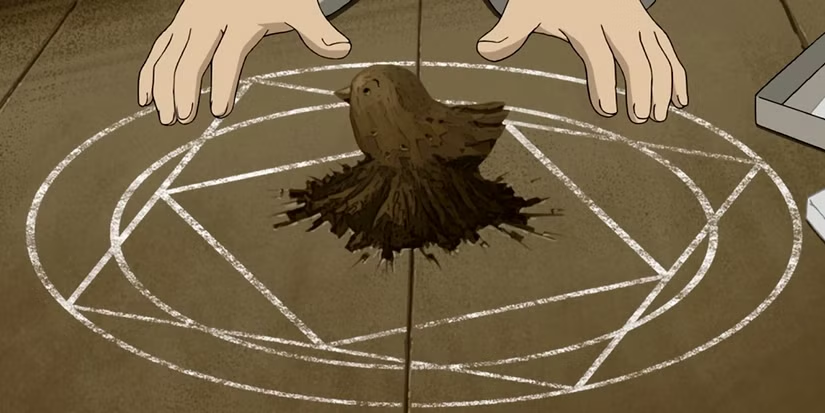
The closest real-world economy to FMA’s ideal isn’t capitalism or Marxism. It’s the gift economy — a framework documented by anthropologist Marcel Mauss in his 1925 work The Gift, which argues that all exchange carries social obligation beyond the material transaction. You give because giving creates relationship, not just because you expect equal return. The exchange is never fully closed.
Which is quietly what Arakawa was building toward the whole time. The philosopher’s stone — the ultimate alchemy shortcut — is horrifying precisely because it reduces people to pure fuel. It treats humans as resources in a ledger. The series positions that as the actual sin, not the ambition.
An economy that treats people as inputs rather than participants makes the same mistake. The math might balance. The exchange might technically complete.
The Gate still opens eventually.