
Araragi Koyomi doesn’t remember Shinobu’s name.
That’s his story, at least. He refers to her for most of Bakemonogatari as “the apparition,” like she’s a piece of furniture he’s politely ignoring. She’s an eight-hundred-year-old vampire living in his shadow—literally—and he can’t quite recall her name. This isn’t a memory problem. It’s a defense mechanism. And the anime has to figure out how to show you a lie that the liar doesn’t even know he’s telling.
That’s the core problem with adapting Monogatari.
When the Narrator Is the Unreliable One
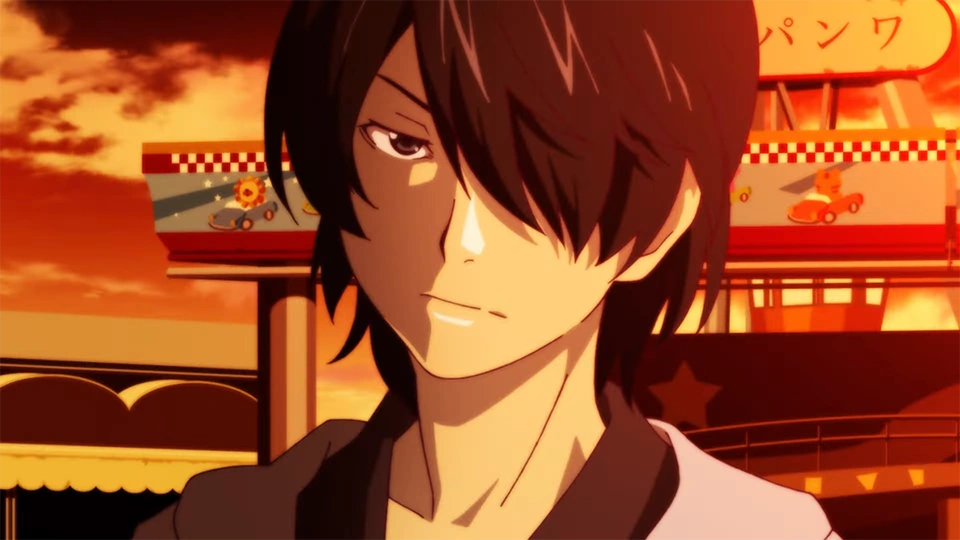
NisiOisin built the Monogatari light novels around a specific trick: Araragi narrates everything, and Araragi is wrong. Not maliciously—he’s not trying to deceive you. He’s deceiving himself, and you’re just along for the ride. In prose, this works through a gap between what he says and what the surrounding text implies. The reader senses the distortion without being told where it is. It’s the literary equivalent of someone smiling while describing something devastating.
Anime doesn’t work that way.
The moment you translate interior monologue into visuals, you’re making choices about what to show. And what you show is, almost by default, more literal than prose. If Araragi says he wasn’t scared, you can write that and let the irony breathe in the surrounding sentences. If you animate him not being scared, the camera is either lying outright or quietly telling the truth his words won’t.
What SHAFT Actually Did
Here’s where the adaptation gets interesting.
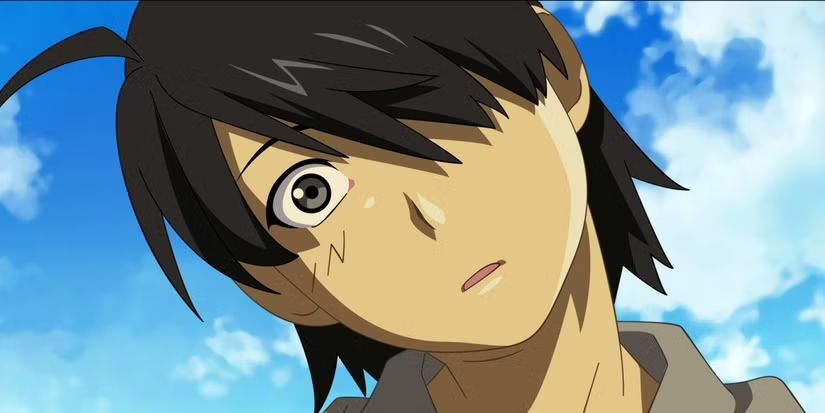
SHAFT and director Akiyuki Shinbo didn’t solve the unreliable narrator problem. They externalized it. Instead of trying to render Araragi’s distorted perspective through conventional animation, they made the entire visual world feel constructed and unstable. The famous flash frames—words, phrases, and images that appear onscreen for a single frame—function as subconscious interruptions, moments where something true bleeds through the narration before Araragi can suppress it. The unnervingly sparse backgrounds, the still frames held during extended dialogue, the deliberate artificiality of the staging: these aren’t just aesthetic flourishes.
They’re telling you not to trust what you’re seeing.
Some of this was born from necessity. Bakemonogatari was produced under significant budget constraints, and SHAFT’s reliance on static frames and minimal movement during dialogue was partly a production solution. But Shinbo’s team had the creative intelligence to transform that limitation into a language. When you watch two characters talking in front of a flat geometric shape that vaguely suggests a room, you’re subtly reminded that this is a construction—that the world Araragi describes is mediated by his perception, not yours. The final two episodes of Bakemonogatari were distributed online rather than broadcast because production ran out of time, which became its own strange artifact of that chaotic creative period—a show about unreliable memory, literally incomplete.
The Toothbrush Scene and the Gap Between Words and Images
Nisemonogatari is where the adaptation’s central tension becomes impossible to ignore.
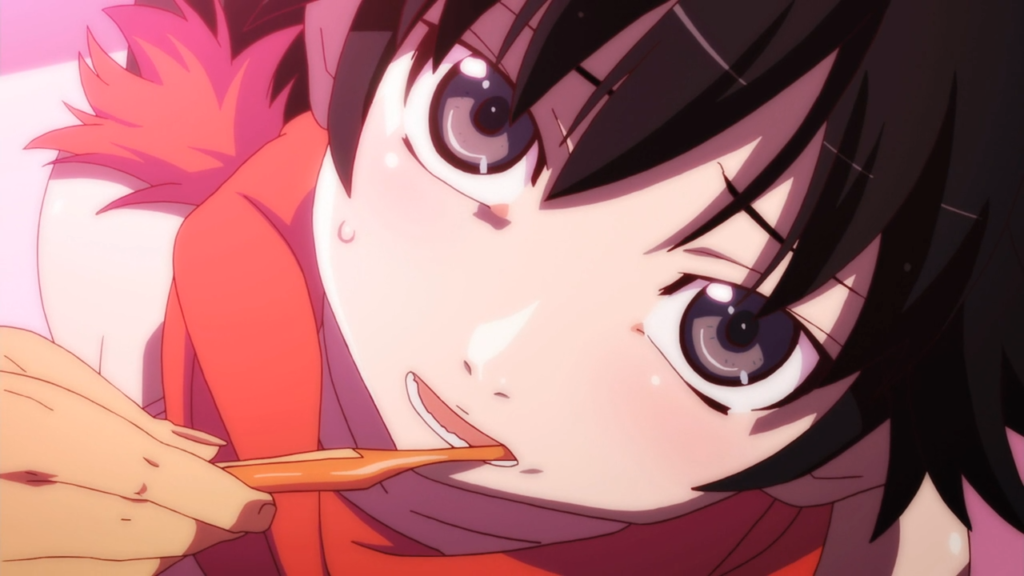
The arc involves Araragi and his sister Karen, culminating in a scene where he brushes her teeth in a way that is, generously described, extremely uncomfortable. Araragi narrates the whole thing with his usual deflection—playful, self-deprecating, framing it as harmless family weirdness. The visuals do not agree with him. The camera lingers. The scene is lit and scored in a way that directly contradicts every “this is fine” note in his voiceover.
This gap is the point.
NisiOisin has been consistently interested in characters who do problematic things and then construct stories for themselves about why they didn’t. Araragi is a pathological helper who cannot admit that his helping is sometimes about control—over others, over his own self-image as a good person. The anime cannot tell you this in narration, because the narrator is the problem. It has to show you the dissonance between his self-image and the reality onscreen. The toothbrush scene lands because SHAFT’s visual choices refuse to validate Araragi’s framing. You see what he won’t let himself see.
Kaiki Deishuu and the Only Honest Liar
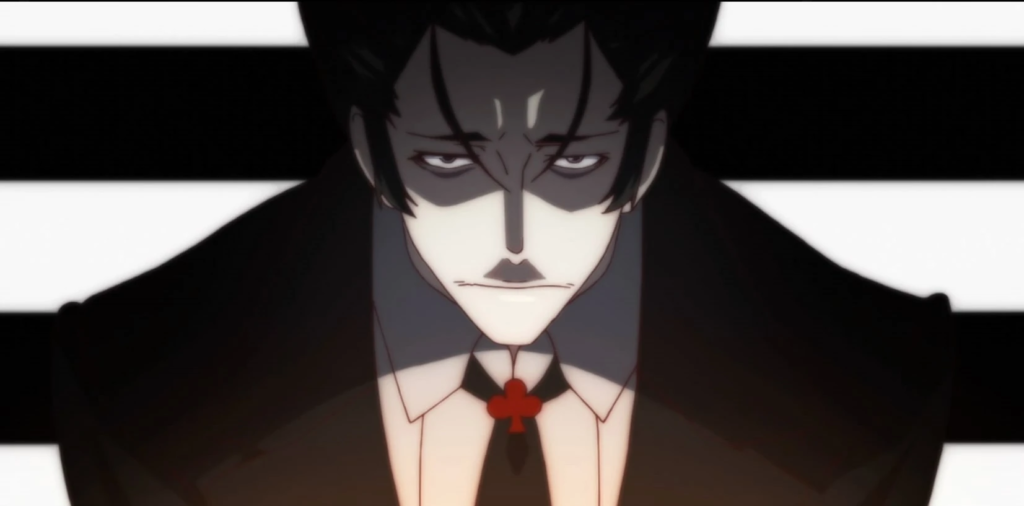
Monogatari Second Season introduced a narrator who handles unreliability completely differently.
Kaiki Deishuu, a con man, opens his arc in Hitagi End by explicitly telling the viewer he’s a fraud, that his motivations are selfish, and that nothing he says should be taken at face value. Then he proceeds to be the most emotionally honest narrator in the entire series.
This is a deliberate inversion. Araragi’s unreliability comes from self-deception—he genuinely believes what he says. Kaiki’s unreliability is announced, performed, weaponized—and yet what emerges through his narration is something closer to the truth than anything Araragi gives you. The anime adapts this through visual contrast: Kaiki’s sequences are shot in muted, unglamorous urban settings. No supernatural lighting. No SHAFT surrealism. Just ugly office buildings, rain-slick streets, and vending machines. The visual register itself signals a different relationship to reality—less filtered, less constructed.
A con man, rendered in the least cinematic way possible, ends up being the show’s most reliable witness.
Hanekawa’s Gaps and the Limit of Adaptation
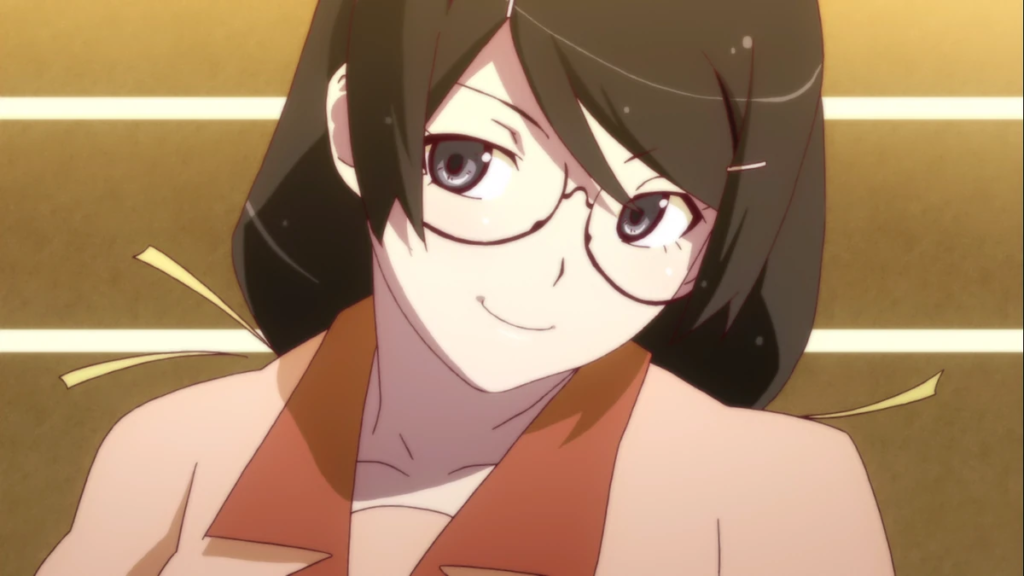
Nekomonogatari (White) pushes the problem to its structural limit.
Hanekawa Tsubasa narrates her own arc, but she’s unreliable in a fundamentally different way: she literally cannot remember what she does when she becomes the cat. Her gaps aren’t lies—they’re genuine absences. The narrator and the protagonist are not quite the same person.
Prose can sit with this ambiguity and let the reader fill the silence. Animation has to make a choice about what to put onscreen. SHAFT’s solution is fragmentary editing and visual discontinuity—Hanekawa’s sequences break apart in ways that mirror her fractured self-knowledge. It works, but it’s more explicit than the novel’s version. The adaptation can suggest the gap; it cannot quite be the gap the way text can.
The Permanent Tension
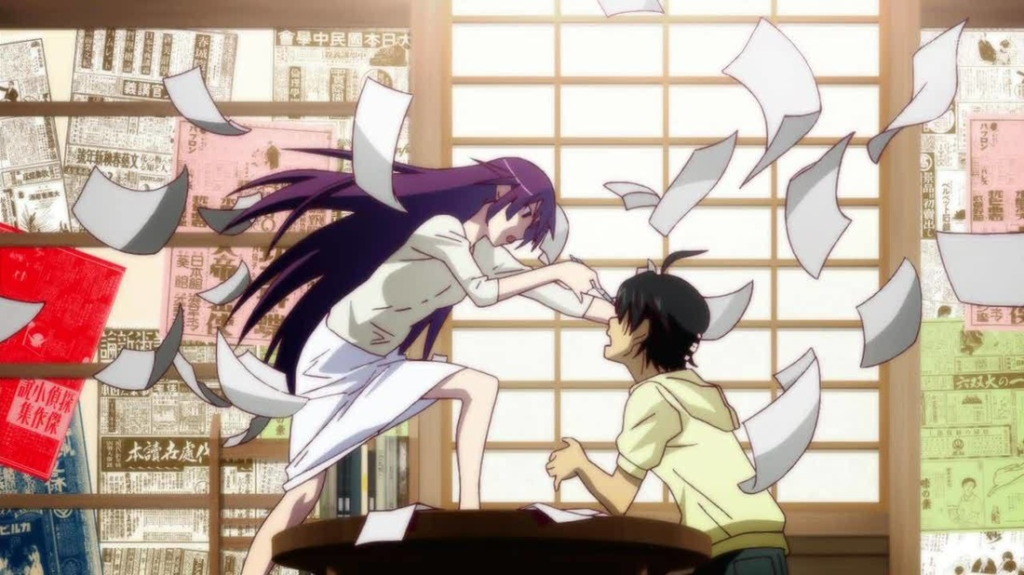
What makes Monogatari‘s adaptation so endlessly fascinating is that it never fully resolves this.
Every tool SHAFT developed—the flash frames, the artificial sets, the visual dissonance between narration and imagery—works because it draws attention to the act of adapting. You’re always aware you’re watching a mediated version of events. The show doesn’t pretend to be transparent.
Araragi lies to himself. SHAFT lies to you. And somewhere in the gap between those two lies, the actual story lives.