

People love calling Puella Magi Madoka Magica a “dark deconstruction” like it showed up to a tea party with a chainsaw. And sure, Episode 3 exists. Mami’s death is the internet’s favorite example of subversion—proof that this show “isn’t like other magical girl anime.”
But here’s the thing nobody mentions when they’re busy diagnosing the series with edgelord syndrome: Madoka isn’t cynical. It’s not sneering at Sailor Moon or Cardcaptor Sakura from some grim grown-up high ground. It’s doing something way more interesting and uncomfortable.
It’s actually taking the genre seriously.
The show asks a question most magical girl anime sidestep: What would it actually mean for a middle schooler to fight for the world? Not in a metaphorical coming-of-age sense, but in the “your body is a resource and someone needs to use it” sense. And then it sits with that question until the discomfort becomes unbearable. That’s not deconstruction through contempt. That’s deconstruction through respect so intense it becomes horrifying.
Deconstruction Doesn’t Mean “Everything Sucks Now”
The word “deconstruction” gets thrown around like it means “dark version” or “realistic take.” It doesn’t. Deconstructing a genre means examining its core assumptions, turning them over in your hands, and asking what they look like from an angle nobody wanted to check.
Magical girl anime runs on a specific emotional contract: young girls gain power, fight evil, and grow up in the process. The transformation sequences are about becoming your ideal self. The battles represent internal struggles made external. Friendship saves the day because cooperation and emotional honesty are genuinely powerful forces.
Madoka Magica doesn’t reject any of that.
It just removes the safety net.
When Kyubey offers Madoka a contract, he’s not lying. The wish system works exactly as advertised. You get what you ask for—Sayaka wishes for Kyosuke’s hand to heal, and it does. Mami, bleeding out alone in a car crash, wishes to keep living, and she does. The magic is real, the power is real, the ability to change reality through sheer emotional conviction is real.
The horror comes from what happens next.
Because in most magical girl shows, the supernatural threat exists in a sort of narrative vacuum. Defeating it restores normalcy. But in Madoka’s world, becoming a magical girl means accepting that you’re now infrastructure. The universe runs on your despair. Your emotional breakdown isn’t a narrative low point before the triumphant comeback—it’s an energy source waiting to be harvested.
That’s not cynicism. That’s just following the premise to its logical endpoint without flinching.
The Witch System Is About Labor, Not Evil
Here’s where the show gets uncomfortable in ways most analyses skip over: the magical girl-to-witch pipeline isn’t about corruption or moral failure.
It’s about burnout.
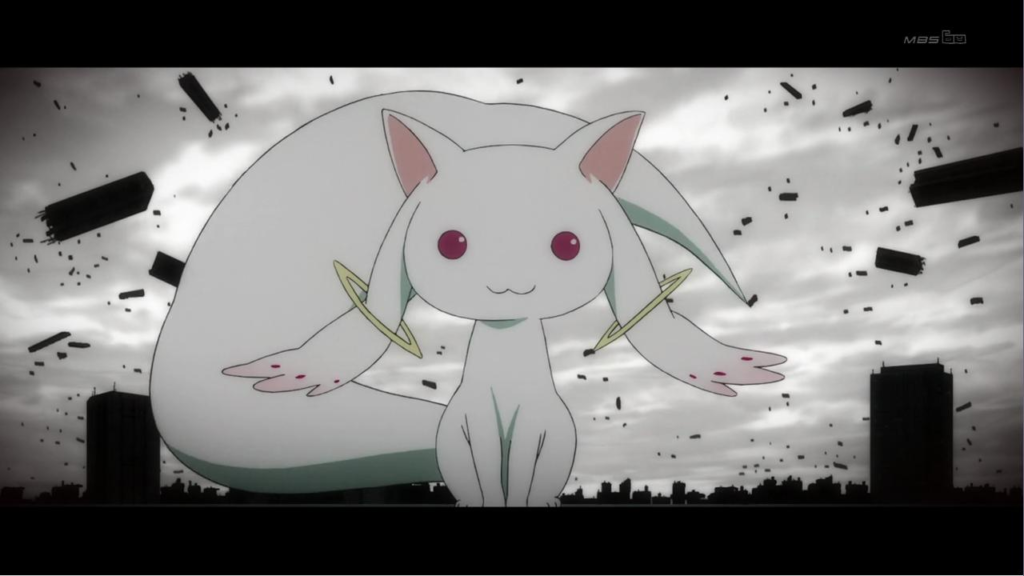
Kyubey doesn’t tempt these girls into darkness. He offers them exactly one moment where their feelings have ultimate power—the wish—and then immediately turns those same feelings into a resource extraction system. You fight because you have to. You fight until you can’t anymore. And when you break, the system converts your breaking point into the next problem for someone else to solve.
This maps uncomfortably well onto real-world labor systems, and the show knows it. Kyubey speaks in the language of utilitarian efficiency. He’s not evil—he’s doing thermodynamics. The emotional energy of teenage girls prevents the heat death of the universe, so harvesting it is simply rational. He can’t understand why they’re upset about it. The system works.
The show aired in 2011, two months before the Tōhoku earthquake and Fukushima disaster reshaped Japan’s relationship with institutional trust and invisible costs. While Gen Urobuchi wrote the series before 3/11, the timing meant audiences encountered it in a moment when “the system works, so individual suffering is justified” had become a viscerally immediate question. What price is acceptable? Who decides? What do you do when the people explaining the necessity can’t feel the cost?
Kyubey is the perfect antagonist for that moment—not because he’s evil, but because he’s completely sincere.
Homura’s Time Loops Aren’t About Obsession—They’re About Information
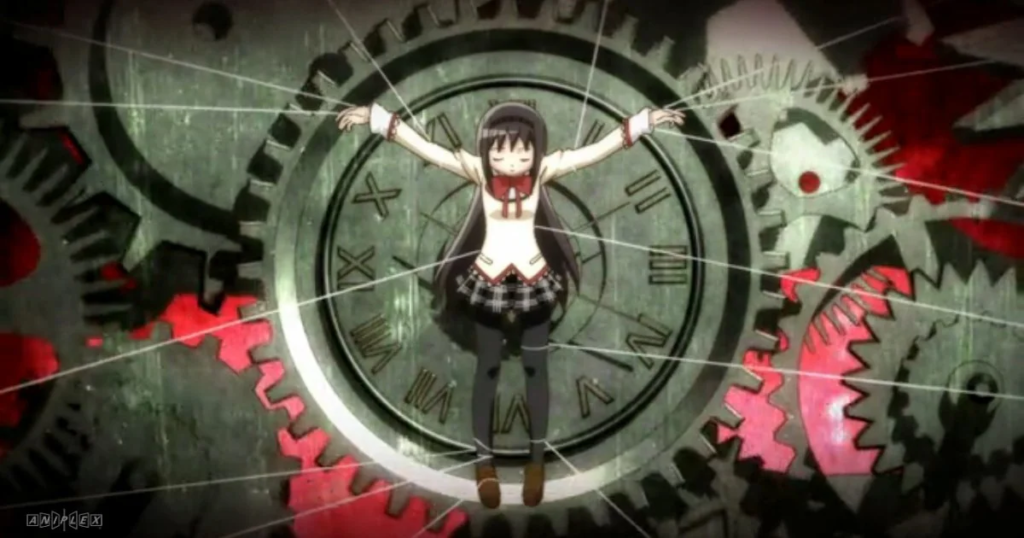
Homura gets written off as the obsessive lesbian who can’t let go. And yes, she’s both obsessive and extremely gay. But reducing her arc to “unhealthy attachment” misses what the time loops actually represent in the show’s structure.
She’s the only character who knows the full cost.
Every other magical girl in the series operates on incomplete information. They make contracts, discover the Soul Gem truth, learn about witches—each revelation hits like trauma because they trusted a system that was using them. But Homura already knows. She’s done this dozens, maybe hundreds of times. She knows exactly how the wish will twist, exactly when Sayaka will break, exactly what Madoka will sacrifice.
And she keeps trying anyway.
That’s not cynicism. That’s the opposite of cynicism. A cynical character would accept the inevitable and stop fighting. Homura’s entire existence is a rejection of inevitability—a sustained, mathematically doomed effort to find the one timeline where the person she loves doesn’t have to die for the universe.
The show even visualizes this through her weapon progression. In her earliest loops, she’s powerless—no combat skills, minimal magic, desperate improvisation. She builds pipe bombs. She steals firearms. Each loop adds more firepower, more tactical knowledge, more cold efficiency, because she’s learning, adapting, refusing to accept that Walpurgisnacht is unbeatable. She turns herself into a walking arsenal, accumulating enough stolen military equipment to fight a small war.
The tragedy isn’t that she’s obsessed. It’s that she’s right to keep trying, and it still doesn’t work. Not because she lacks strength, but because the structural inevitability of Madoka’s karmic weight makes her sacrifice unavoidable. Homura can protect Madoka from witches, from Walpurgisnacht, from every physical threat—but she can’t protect her from becoming the universe’s emergency exit.
Madoka’s Wish Doesn’t “Fix” Anything—It Redistributes the Cost
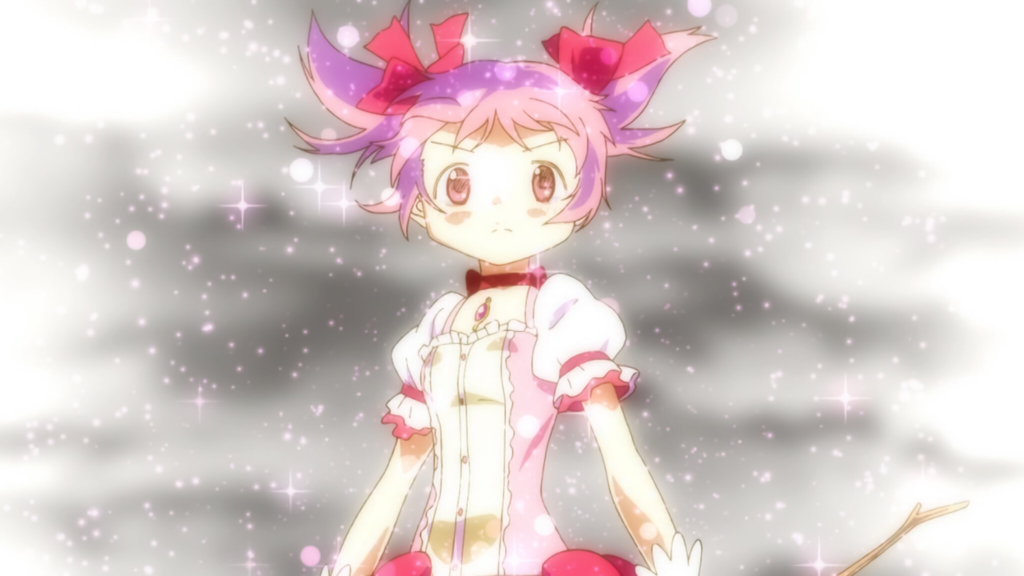
The ending catches people off guard because it looks like a happy resolution, then sits in your brain and starts itching.
Madoka wishes to erase all witches at the moment they would be born, across all timelines. She removes herself from existence as a human and becomes a conceptual force—the moment before despair, the hand that catches magical girls as they fall. The Soul Gem system still exists. Girls still fight. They still die. But they don’t become the thing they fought against.
Is that a happy ending?
It’s definitely hopeful, which isn’t the same thing. The show distinguishes between those concepts carefully. Hope isn’t “everything works out.” Hope is “the suffering means something different now.” Madoka doesn’t eliminate the cost of being a magical girl—she reframes it. Instead of your breakdown fueling entropy, your final moments become a return to something like grace. You disappear, but not into despair.
The new universe still asks girls to fight and die. It’s still not fair. Kyubey still exists, still making contracts—though he’s lost access to the energy of despair and no longer understands how the universe is being stabilized. The Incubators are confused, almost frightened by the system Madoka created. They’re no longer the ones benefiting.
But the emotional truth of that sacrifice changed. That’s not a small thing, even if it’s not salvation.
And the show doesn’t pretend it is.
Homura remembers the old world. She’s the only one who knows what Madoka gave up, which means she’s the only one carrying the full weight of what hope cost. The final scene shows her fighting alone in a world that doesn’t remember why it’s better now. She knows the truth, and it doesn’t comfort her.
But she keeps fighting anyway.
Why the Genre Elements Still Matter
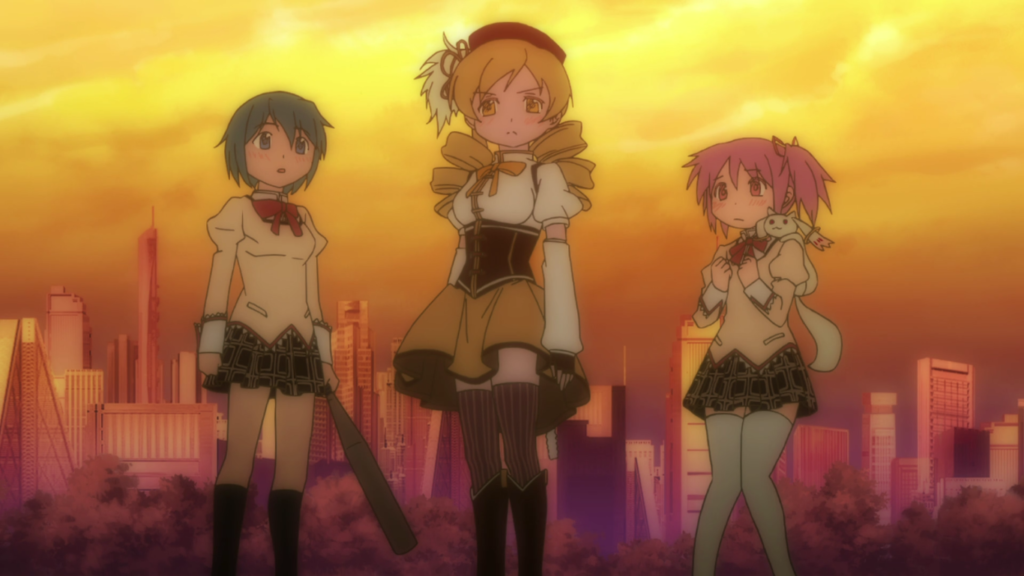
Here’s what separates Madoka from actual cynical deconstructions: it never mocks the things magical girl anime care about.
Friendship still matters. Sayaka’s breakdown happens specifically because she can’t talk to Madoka and Hitomi about what she’s feeling. The isolation kills her, not the Soul Gem system. Mami dies because she’s been alone for so long that Madoka’s friendship makes her reckless with hope—she lets her guard down for the first time in years, and that momentary vulnerability is exactly when Charlotte strikes from inside her labyrinth.
Transformation sequences still matter. The show keeps them, doesn’t parody them, lets them be beautiful. Because that moment of becoming your idealized self is real, even if what comes after is brutal. The magic doesn’t lie. The power is exactly what it promises. The problem isn’t that magical girls are silly or naive—it’s that the truth they’re expressing is being harvested by something that can’t value it.
Even the pastel color palette and Gekidan Inu Curry’s witch designs work in conversation with the genre, not against it. The witches look like corrupted magical girl imagery because that’s what they are. The aesthetic isn’t “dark magical girls”—it’s “magical girls rendered in the visual language of what happens when the system breaks them.”
The show loves the genre. That’s why the deconstruction hurts.
Gen Urobuchi’s Problem With Happy Endings (And Why Madoka Isn’t One)
Gen Urobuchi’s nickname is “Urobutcher” for a reason—Fate/Zero, Psycho-Pass, Saya no Uta. The man writes tragedy like it’s his job, because it literally is. But calling him nihilistic misreads what he’s actually doing in most of his work.
He’s obsessed with the gap between ideals and reality. Characters who believe in something beautiful, then watch the world demonstrate why that beautiful thing can’t exist in its pure form. Not because ideals are stupid, but because reality is complicated and costly and indifferent to what we wish was true.
Madoka Magica is that obsession distilled into twelve episodes.
The magical girl genre is built on ideals—love, justice, hope, friendship as literal supernatural forces. Madoka asks: what if those forces were real, completely real, and the universe still didn’t care? What if hope was powerful enough to rewrite reality, and that power was exactly why someone would exploit it?
The answer the show lands on isn’t “hope is pointless.” It’s “hope is so valuable that systems will form to extract it from the people who feel it most intensely.” That’s darker than nihilism. Nihilism would be easier.
The series resolves on Madoka making a choice that doesn’t save anyone from suffering, but does save them from meaninglessness. The magical girls in the new universe still die fighting. But they die as themselves, not as corrupted inversions of what they believed in. Their hope doesn’t get turned into fuel for despair.
That’s the closest thing to a happy ending Urobuchi knows how to write—not salvation, but dignity.
The Thing About Magical Girls and Contracts
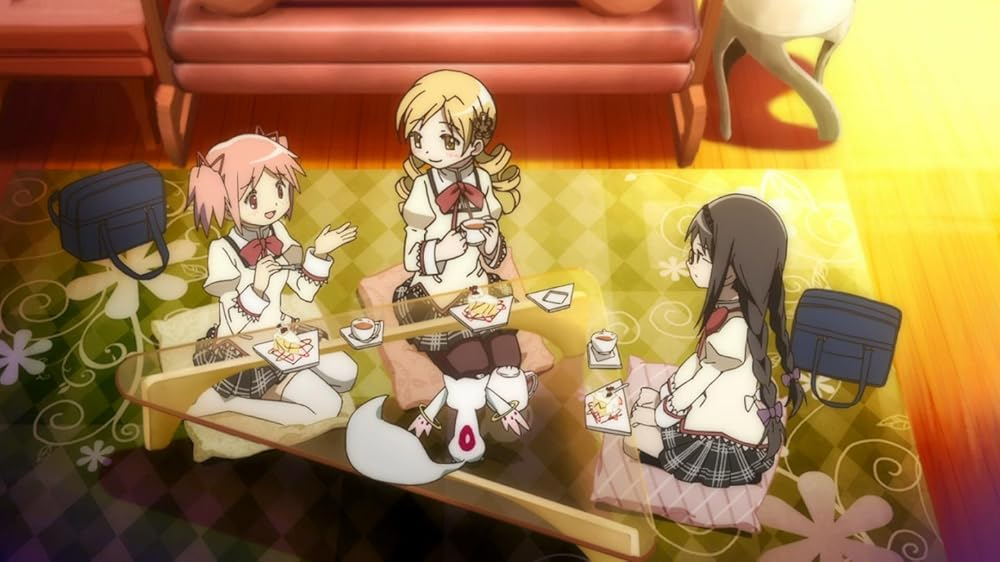
Most magical girl anime skips the part where someone explains why middle schoolers specifically are fighting cosmic evil. Sailor Moon has reincarnation and destiny. Cardcaptor Sakura has inherited magical talent. Precure has chosen warriors. The “why you” question gets answered in the first episode and then everyone moves on.
Madoka makes that question the whole point.
Why teenage girls? Because they feel things intensely enough to generate usable energy. Because they’re old enough to articulate a wish but young enough that their understanding of consequences is still developing. Because they exist in that specific window where hope and despair can oscillate wildly, sometimes in the same day. Because the system works best on people who haven’t yet learned to protect themselves from exploitation.
Kyubey isn’t targeting them randomly. He’s targeting them because they’re optimal resources.
And that framing turns every magical girl transformation sequence you’ve ever seen into a question: what was the contract? Who benefited? What was the cost, and who paid it?
The show doesn’t answer that for other series—it’s not a commentary track on the whole genre. But it creates a frame where those questions become visible. Once you’ve seen Madoka, you can’t watch a twelve-year-old gain cosmic power without wondering what the universe is getting out of the deal.
That’s what effective deconstruction does. It doesn’t replace the thing it’s examining—it makes you see its shape more clearly.
Why This Still Feels Like Hope
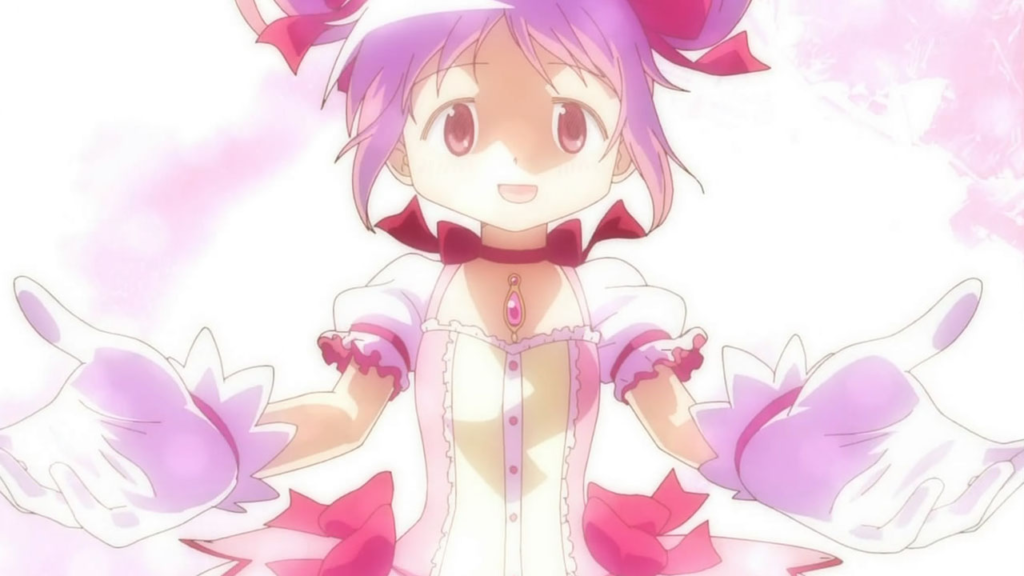
For all the despair and entropy and cosmic indifference, Madoka Magica ends on Homura fighting in a field of flowers.
That image matters. The new universe isn’t better in any material sense—magical girls still fight, still sacrifice, still disappear. But it looks different. Homura’s fighting alone, but she’s not fighting in darkness. The aesthetic has changed because the meaning has changed.
And she’s still fighting.
That’s the thesis the show kept circling back to, underneath all the Faustian contracts and thermodynamics: the choice to keep fighting, even when you know the cost, even when you know it won’t save you, transforms the nature of the fight itself. Not into victory. Into something that resembles meaning.
Madoka didn’t create a happy ending. She created an ending where hope gets the last word instead of despair, even if that word is spoken in silence as another magical girl disappears into the conceptual boundary she’s maintaining.
Is that enough?
The show’s smart enough not to answer. It just shows you Homura, alone, fighting, surrounded by flowers that wouldn’t exist in the old timeline. And lets you sit with what that means.
Because here’s the thing about deconstructing magical girls: you have to understand why they matter first. Why little girls fighting cosmic evil resonates, why transformation sequences feel meaningful, why friendship and hope and justice work as narrative forces even when they shouldn’t.
Madoka Magica understands all of that intimately.
It just refuses to look away from what it costs.